
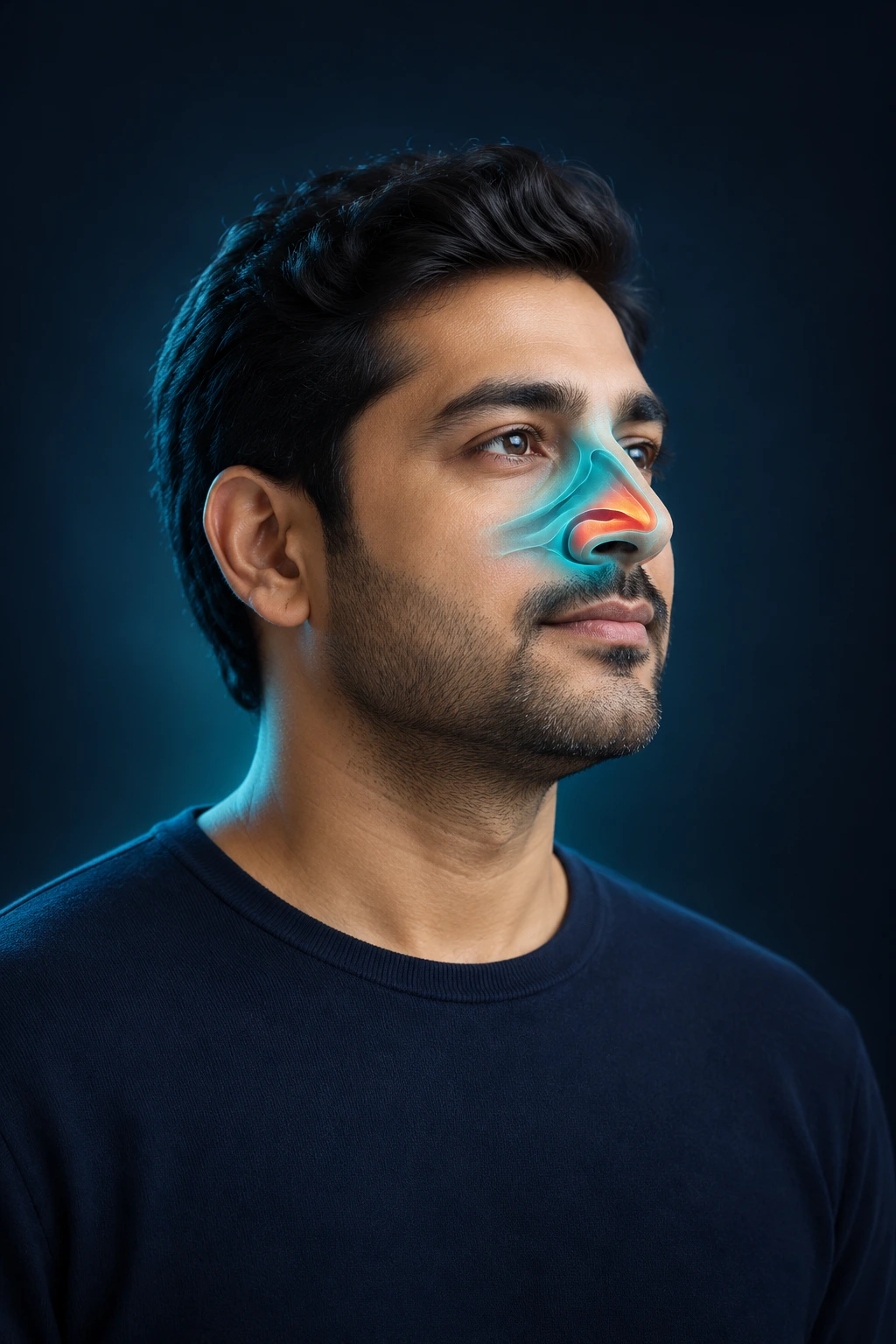
Surgery is considered only after identifying why the turbinates are enlarged and whether appropriate medical treatment has been used. The objective is comfortable airflow, not removal of as much tissue as possible.
Why Do Turbinates Become Enlarged?
Turbinates naturally swell and shrink as part of the nasal cycle. Persistent enlargement may be associated with:
- Allergic rhinitis
- Non-allergic or irritant rhinitis
- Long-term inflammation
- Compensatory swelling beside a deviated septum
- Overuse of decongestant nasal sprays
- Hormonal or environmental factors
Symptoms commonly include alternating or constant nasal blockage, mouth breathing, sleep disturbance, reduced exercise comfort and a sensation that sprays do not reach deep enough. Enlarged turbinates can coexist with septal deviation, polyps or sinus disease, so turbinate treatment alone may not correct every obstruction.
Assessment Before Turbinate Reduction
The ENT specialist examines the nose before and after decongestion to understand how much of the blockage comes from reversible swelling. Diagnostic nasal endoscopy shows the turbinates, septum and deeper nasal passages. Allergy history, response to sprays and duration of symptoms are reviewed.
First-line care often includes saline irrigation, correct use of prescribed intranasal steroid sprays, allergy control and avoiding topical decongestant overuse. Surgery may be discussed when significant obstruction persists despite adequate treatment or when structural enlargement is unlikely to respond sufficiently to medicine.
Correct spray technique can make a meaningful difference: the nozzle is generally aimed away from the nasal septum and towards the outer wall, according to the clinician’s instructions. Patients who stop treatment because of irritation, bleeding or no improvement should be re-examined rather than increasing the dose independently.
Turbinate Procedures Compared
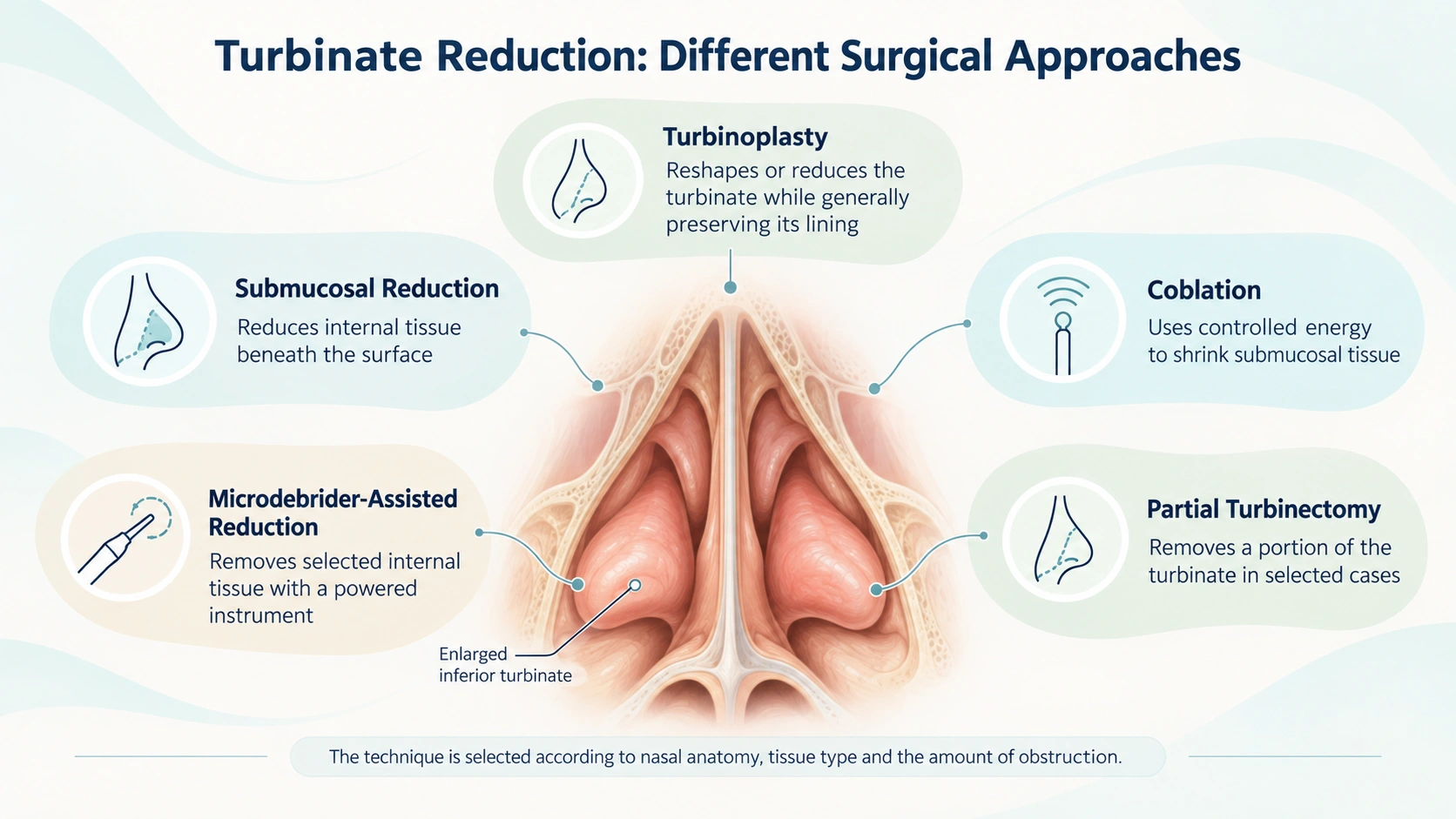
Modern functional treatment usually favours conservative volume reduction because turbinates are essential for humidification and comfortable airflow. The method depends on tissue type, anatomy, prior treatment and associated septal deviation.
The procedure is performed under local or general anaesthesia depending on the method and associated operations. It may be completed alone or combined with septoplasty when both turbinate enlargement and a deviated septum contribute to obstruction.
The goal is not to create the widest possible cavity. Nasal comfort depends on smooth, humidified airflow, so an appropriately sized functional passage is more important than aggressive tissue removal.
Recovery and Aftercare
Temporary stuffiness is expected because swelling and crusting occur while the lining heals. Mild blood-stained discharge can appear during the early period. Saline rinses, prescribed medicines and follow-up cleaning support recovery.
Avoid nose blowing, heavy exercise, dust and smoke during early healing. Improvement is usually gradual rather than immediate. Allergy treatment may still be needed after surgery because reducing turbinate size does not remove the underlying allergic tendency.
Expected Benefits
- More comfortable nasal airflow
- Less mouth breathing and congestion
- Improved access for prescribed nasal sprays
- Preservation of humidification when tissue is reduced conservatively
Possible Risks
- Bleeding, infection or temporary crusting
- Dryness or scar formation
- Persistent blockage or tissue regrowth
- Abnormal airflow sensation after excessive tissue removal, which is why tissue-preserving planning matters
Consult for Turbinate Reduction in Indore
If nasal sprays provide incomplete relief, the next step is not automatically surgery. Accurate examination must show whether the main obstruction comes from turbinates, septum, nasal valve, polyps or a combination. Patients considering coblation turbinoplasty or microdebrider-assisted turbinate reduction in Indore can consult Dr. Abhishek Malviya for a function-preserving treatment plan.
FAQ
What are nasal turbinates?
Turbinates are normal structures that filter, warm and humidify inhaled air. Enlargement can narrow the nasal airway.
What is turbinoplasty?
Turbinoplasty reduces or reshapes an enlarged turbinate while aiming to preserve its lining and natural function.
Is turbinoplasty the same as turbinectomy?
No. Turbinectomy removes part of a turbinate, while turbinoplasty generally focuses on conservative tissue reduction and preservation.
Can allergy medicine shrink turbinates?
Prescribed sprays and allergy control often reduce inflammatory swelling. Structural enlargement may remain despite adequate medical treatment.
What is coblation turbinoplasty?
Coblation uses controlled energy to reduce tissue beneath the turbinate lining while limiting thermal injury to surrounding tissue.
What is microdebrider-assisted turbinoplasty?
It uses a powered instrument to remove selected internal turbinate tissue while preserving the surface lining.
Can turbinoplasty be combined with septoplasty?
Yes. They are often combined when both septal deviation and turbinate enlargement contribute to blockage.
Will the turbinates grow again?
Some tissue enlargement can recur, particularly when allergy or irritation remains active. Long-term medical care may still be needed.
Does recovery cause temporary blockage?
Yes. Swelling and crusting can temporarily worsen congestion before breathing gradually improves.
Who offers turbinoplasty in Indore?
Dr. Abhishek Malviya evaluates nasal obstruction and offers coblation- or microdebrider-assisted turbinoplasty when appropriate.
This information is educational. An examination is needed to decide which treatment is appropriate. Benefits, risks and recovery vary between patients.