
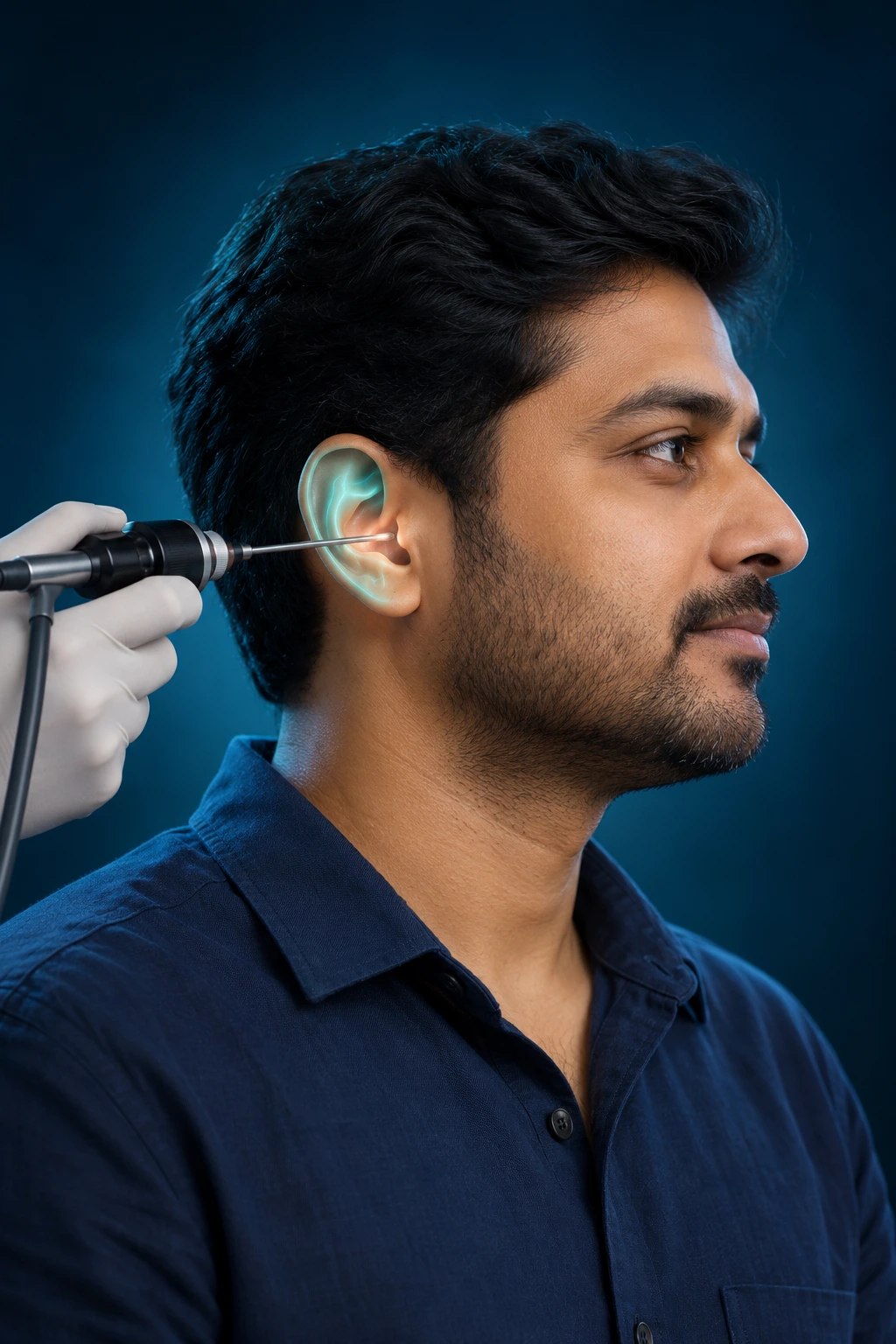
Endoscopy is a surgical tool, not a promise that every ear operation will be scarless. The safest approach may be endoscopic, microscopic or a combination of both depending on the disease.
Which Ear Conditions May Be Treated Endoscopically?
Endoscopic techniques may be considered for selected cases of:
- Eardrum perforation requiring tympanoplasty
- Limited cholesteatoma or retraction-pocket disease
- Middle-ear exploration
- Ossicular chain problems
- Selected congenital or structural abnormalities
- Removal of small middle-ear lesions
The ear canal must allow safe access, and the disease must be reachable through that corridor. Extensive mastoid disease can still require an incision and mastoidectomy. Choosing an endoscope simply because it appears less invasive would be inappropriate if it compromises disease clearance.
How Is Suitability Decided?
Evaluation begins with the symptoms: hearing loss, chronic discharge, recurrent infection, tinnitus or a diagnosed eardrum abnormality. Microscopic and endoscopic ear examination helps define the visible disease. Pure-tone audiometry measures hearing, and a CT scan of the temporal bone may be recommended when cholesteatoma, mastoid involvement or complex anatomy is suspected.
The surgeon considers the size of the ear canal, location of disease, condition of the hearing bones and previous operations. Patients receive an explanation of whether a fully endoscopic procedure is likely or whether conversion to a microscopic or combined approach might be needed.
What Happens During Endoscopic Ear Surgery?
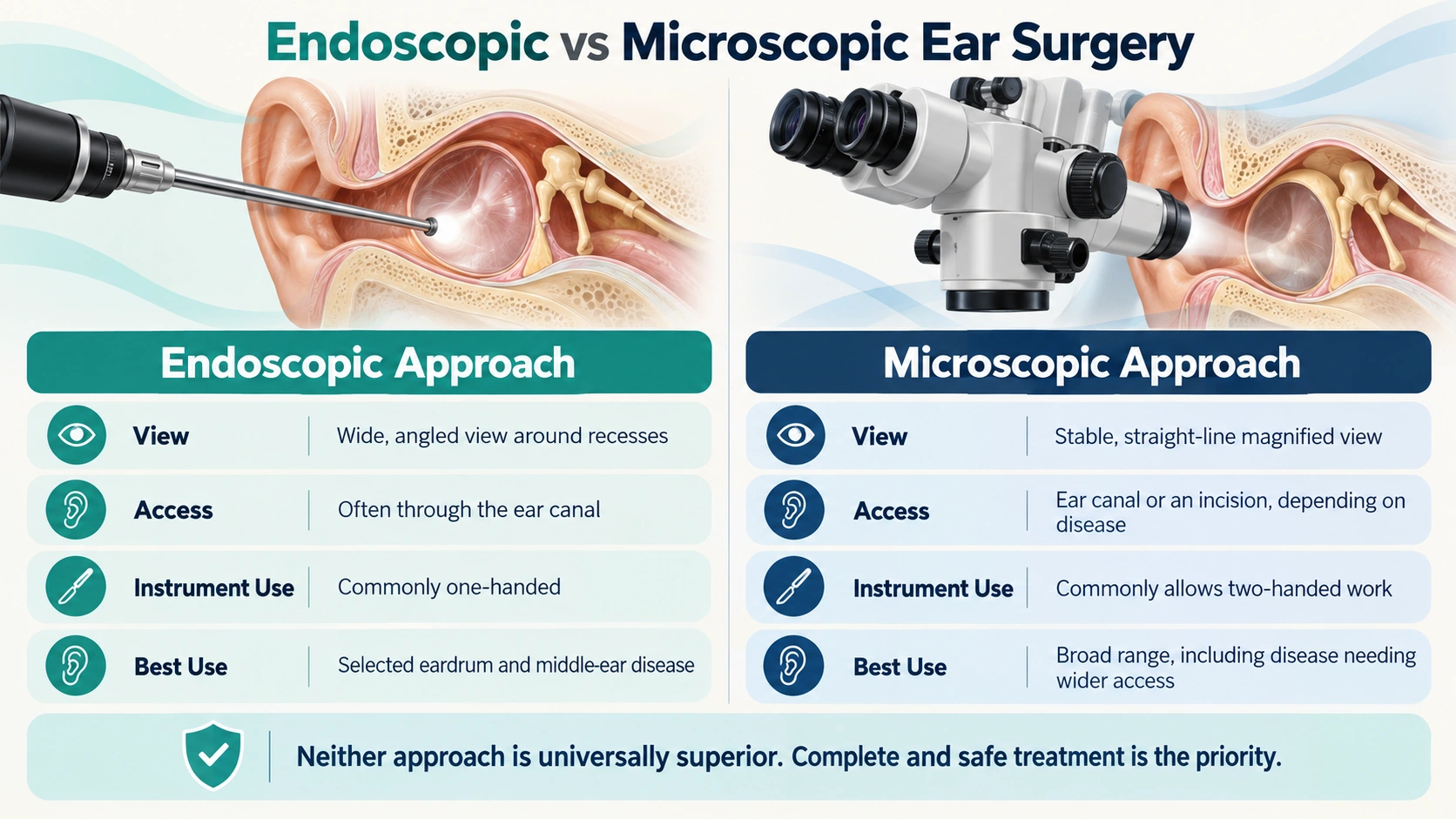
The procedure is usually performed under anaesthesia. The endoscope provides a magnified image on a monitor while the surgeon works through the ear canal using fine instruments. Angled endoscopes can reveal recesses that may be difficult to view directly with a straight line of sight.
The operation varies by diagnosis. A perforation may be repaired with a graft; abnormal skin may be removed; or damaged sound-conducting structures may be reconstructed. Endoscopic surgery is generally a one-handed technique because the other hand holds the camera, so surgical experience and case selection are important.
Endoscopic and Microscopic Ear Surgery
Potential Advantages in Suitable Cases
For suitable cases, the approach may offer:
- Wide and angled visualisation of the middle ear
- Access through the natural ear canal
- A smaller or absent external incision
- Less disturbance of healthy tissue in selected procedures
- Useful documentation and patient explanation through recorded images
These are potential advantages, not guaranteed outcomes. Success is determined by complete treatment of disease, safe healing and the condition of the hearing system.
Recovery and Ear Care
Ear packing can cause temporary blocked hearing after surgery. Mild discomfort, fullness or small amounts of discharge may occur. Patients should keep the ear dry, avoid forceful nose blowing and follow instructions regarding medicines, activity, travel and follow-up.
The surgeon checks graft healing or the operated middle ear at scheduled visits. Hearing is commonly reassessed after swelling has settled. Cholesteatoma and other recurrent conditions may require longer surveillance, even when the initial result is satisfactory.
Risks and Realistic Expectations
Possible risks depend on the operation and include infection, bleeding, persistent perforation, altered taste, tinnitus, dizziness, hearing change or recurrence of disease. Rare injury to nearby structures is discussed for relevant procedures. Endoscopy does not remove these risks; its value lies in improved visual access for the right case.
Consult for Endoscopic Ear Surgery in Indore
Patients should choose the surgical approach after diagnosis, not before it. If you are exploring minimally invasive ear surgery in Indore, Dr. Abhishek Malviya can assess the ear, review hearing and imaging, and explain whether endoscopic, microscopic or combined ear surgery offers the most appropriate treatment.
FAQ
What is endoscopic ear surgery?
It is ear surgery performed using a small camera through the ear canal to view and treat selected eardrum and middle-ear conditions.
Is endoscopic ear surgery scarless?
Some operations can be completed without an external incision, but others require a small incision or combined approach for safety.
Is it better than microscopic ear surgery?
Neither is universally better. The diagnosis, anatomy and extent of disease determine which approach provides safer and more complete treatment.
Can cholesteatoma be removed endoscopically?
Selected limited disease may be suitable. Extensive cholesteatoma involving the mastoid often requires a broader or combined approach.
Can tympanoplasty be done endoscopically?
Yes, many suitable eardrum perforations can be repaired endoscopically through the ear canal.
Is a CT scan always needed?
Not always. It may be advised when deeper disease, cholesteatoma, mastoid involvement or complex anatomy is suspected.
How soon will hearing improve?
Packing and swelling can temporarily block hearing. Improvement is assessed after sufficient healing and varies with the underlying ear condition.
Can children undergo endoscopic ear surgery?
Yes, selected children may be candidates, depending on canal size, disease and the surgeon’s assessment.
Can surgery switch from endoscopic to microscopic?
Yes. The surgeon may use a microscope or make an incision if required to treat disease safely and completely.
Who offers endoscopic ear surgery in Indore?
Dr. Abhishek Malviya evaluates patients for endoscopic, microscopic and combined ear surgery approaches in Indore.
This information is educational. An examination is needed to decide which treatment is appropriate. Benefits, risks and recovery vary between patients.