
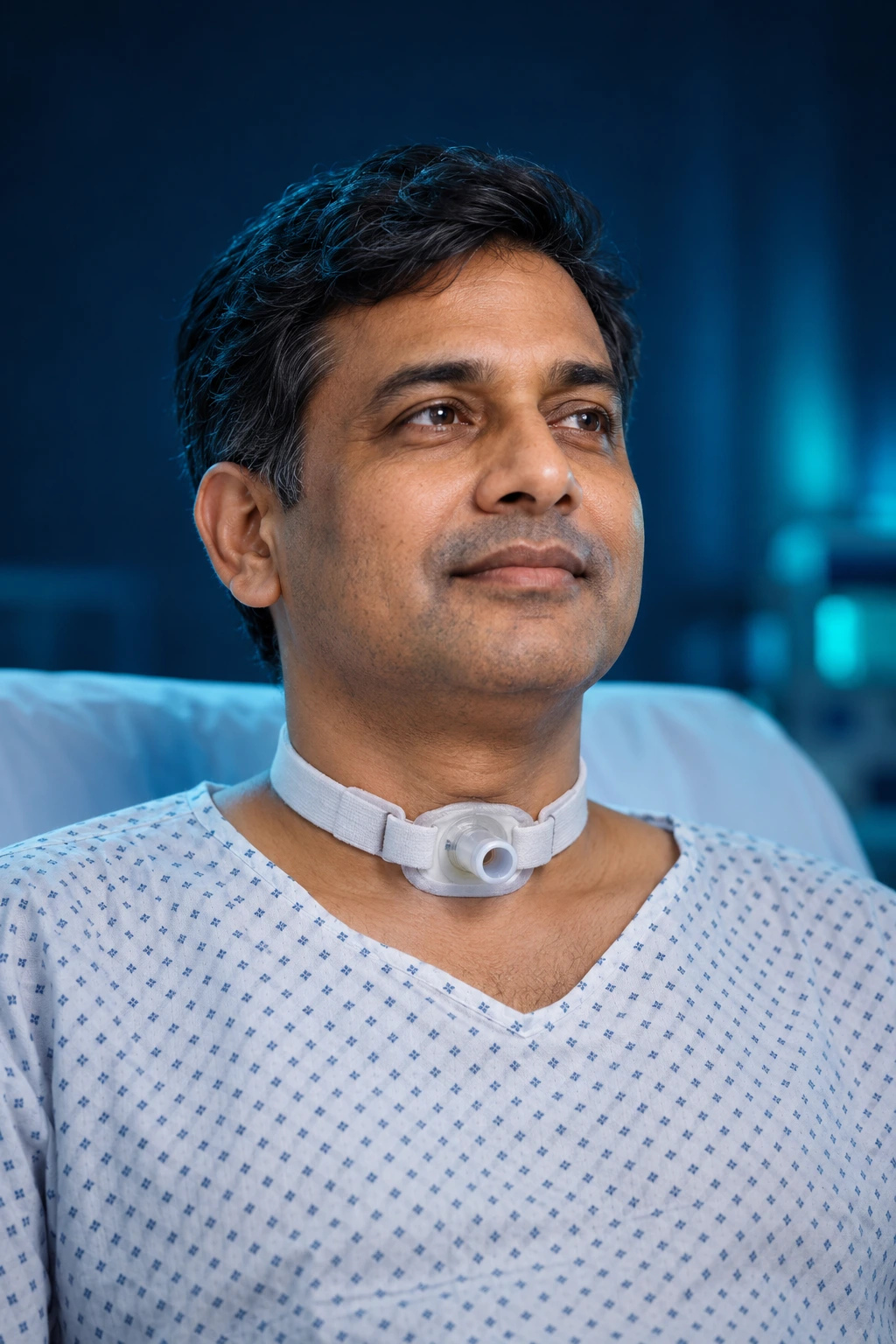
A tracheostomy is not simply a procedure. Safe treatment requires coordinated anaesthesia, critical-care, nursing, respiratory and rehabilitation support within a properly equipped hospital.
When May a Tracheostomy Be Needed?
Clinical situations can include:
- Severe upper-airway obstruction
- Swelling, trauma or a mass involving the throat or voice box
- Need for prolonged mechanical ventilation
- Neurological inability to protect the airway
- Difficulty clearing secretions effectively
- Recovery after selected major head and neck operations
- Bilateral vocal cord immobility or another critical airway disorder
Noisy breathing, stridor, rapidly worsening breathlessness, bluish lips, inability to speak normally, drooling or collapse requires immediate emergency care. A website enquiry or routine appointment is not appropriate for active breathing difficulty.
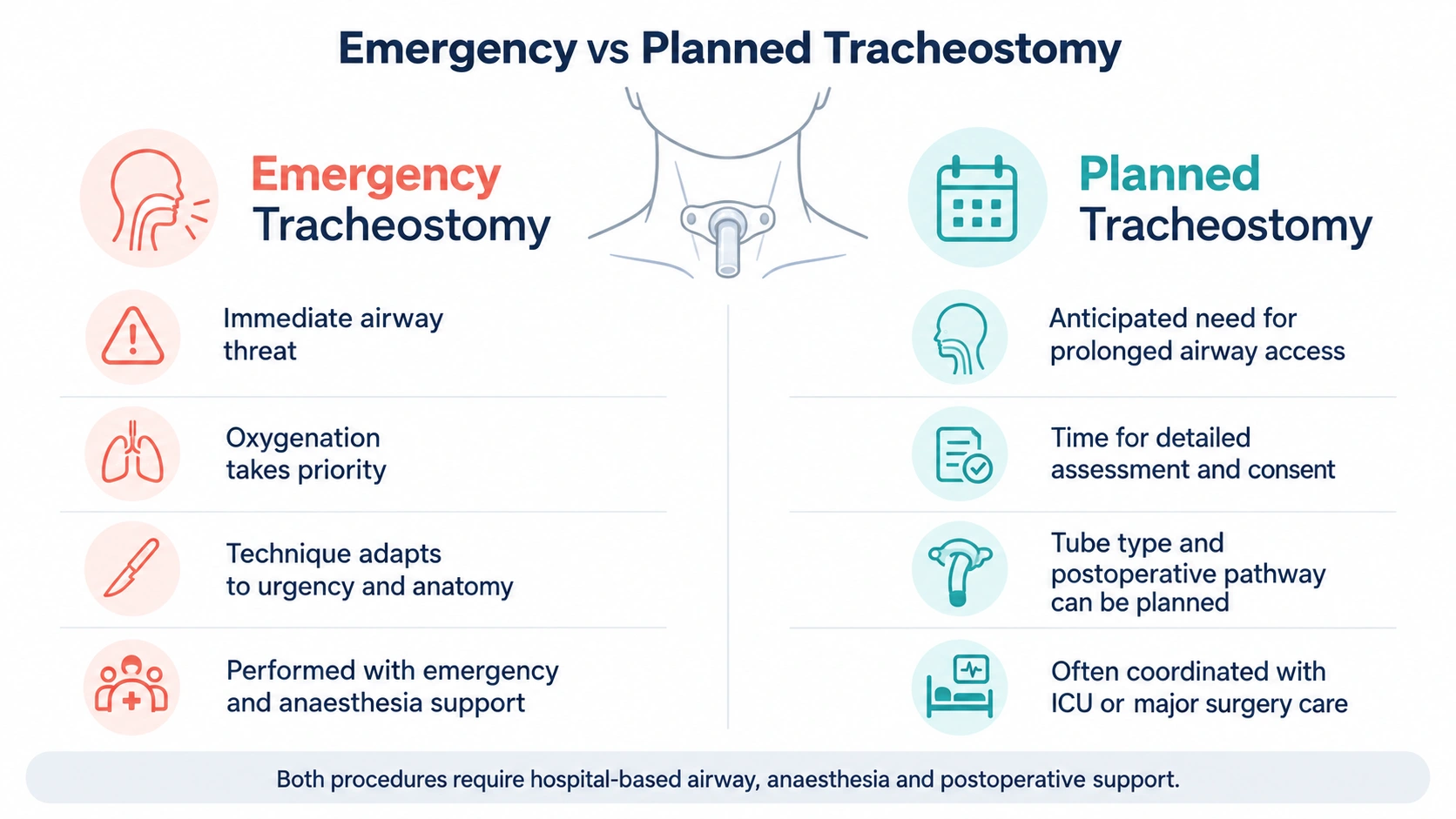
Emergency and Planned Tracheostomy
Some intensive-care patients may be suitable for percutaneous tracheostomy, while others require an open surgical procedure. The treating team determines the safest option.
What Happens During Surgical Tracheostomy?
The patient is positioned and monitored, and anaesthesia is selected according to the clinical situation. The surgeon makes an incision in the lower front of the neck, separates tissues carefully and creates an opening in the trachea. A tracheostomy tube is inserted and secured. Correct airflow, oxygenation and tube position are confirmed before postoperative monitoring.
The tube has an outer part that keeps the opening patent, and some designs contain an inner cannula that can be cleaned or changed. Cuffed tubes may be needed for ventilated patients, while different tubes are used as recovery progresses.
Tube size and design are selected for the patient’s anatomy, ventilation requirement and ability to manage secretions. The first tube change is normally performed by trained clinicians because the tract is still developing and accidental loss of the airway can be dangerous.
Daily Tracheostomy Care Priorities
Humidification is essential because inhaled air no longer passes through the nose, which normally warms and moistens it. Secretions may require suction, and the skin around the opening needs regular cleaning. Staff and caregivers are taught tube security, inner-cannula care, suction technique and emergency actions.
Communication may be difficult initially because airflow is redirected away from the vocal cords. When medically suitable, cuff adjustment, a speaking valve or tube change can support speech under professional supervision. Swallowing assessment may also be required before oral feeding.
Is a Tracheostomy Permanent?
Not always. Many are temporary. Decannulation, the planned removal of the tube, is considered when the original airway problem has resolved, breathing is stable, secretions can be managed and swallowing or airway protection is adequate. The opening often closes naturally, though some patients need surgical closure. Permanent tracheostomy may be required when long-term airway obstruction cannot be reversed.
Risks and Warning Signs
Early risks include bleeding, blockage, displacement, infection and air leakage into surrounding tissue. Later problems can include granulation tissue, tracheal narrowing, scar formation and difficulty during tube changes.
Seek immediate trained help for:
- Sudden breathing difficulty
- Inability to pass a suction catheter
- A blocked or displaced tube
- Heavy bleeding
- Rapidly falling oxygen levels
Tracheostomy and Airway Care in Indore
The correct outcome depends not only on creating the airway but also on safe postoperative care and a plan for recovery. Dr. Abhishek Malviya manages suitable tracheostomy cases in Indore as part of multidisciplinary hospital-based ENT and airway care. Anyone experiencing active respiratory distress should go directly to the nearest emergency department.
Do not delay emergency transport while arranging a routine consultation.
FAQ
What is a tracheostomy?
A tracheostomy is a surgically created opening in the windpipe through the neck, with a tube placed to support breathing.
Is tracheostomy always an emergency procedure?
No. It may be performed urgently for obstruction or planned for prolonged ventilation and other long-term airway needs.
Can a person speak with a tracheostomy?
Speech may be possible with suitable tube adjustments or a speaking valve after the medical team confirms that it is safe.
Can a person eat after tracheostomy?
Many can, but swallowing should be assessed when there is concern about aspiration or neurological weakness.
Is a tracheostomy permanent?
It may be temporary or permanent depending on whether the original airway problem resolves.
How is the tube cleaned?
Care involves humidification, suction when needed, cleaning the inner cannula and keeping the surrounding skin clean according to training.
What if the tube comes out?
Accidental displacement can be an emergency. Follow the hospital’s emergency plan and seek immediate trained medical help.
What is decannulation?
Decannulation is planned removal of the tracheostomy tube after breathing, airway protection and secretion management are assessed as adequate.
What symptoms require emergency assessment?
Severe breathlessness, stridor, blue lips, collapse, heavy bleeding or a blocked/displaced tube requires immediate emergency care.
Who manages tracheostomy in Indore?
Dr. Abhishek Malviya provides ENT airway assessment and tracheostomy care for appropriate hospital-based cases in Indore.
This information is educational. An examination is needed to decide which treatment is appropriate. Benefits, risks and recovery vary between patients.